
BBA vs B.Com After Class 12: Which Degree Should You Choose for a Management Career in 2027?
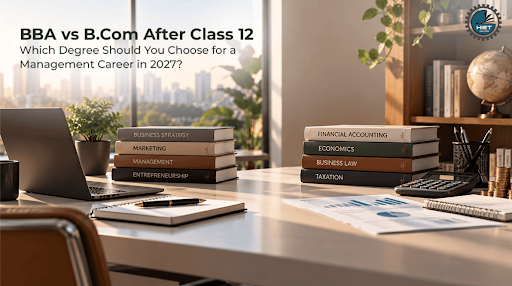
Class 12 is over, and suddenly everyone has advice. Parents lean towards B.Com, friends are eyeing BBA, and you are wondering which one actually builds a career. Take a breath. Both degrees are respected, but they train you differently. If management is your goal for 2027, this guide breaks down subjects, careers, salary, and fees so you can choose with clarity instead of pressure.
BBA or B.Com: What Is the Real Difference?
B.Com goes deep into commerce. You study financial accounting, taxation, auditing, business economics and business law, which suits you if numbers and regulations excite you. It is also a popular base for professional qualifications like CA, CMA or CS.
BBA shows how a whole organisation runs, covering marketing, finance, HR and operations. Think of B.Com as learning to read a business’s financial story, and BBA as learning to lead it. The two overlap, and the exact syllabus varies by university.
| Comparison | BBA | B.Com |
| Main focus | Business management and organisational functions | Commerce, accounting and finance |
| Core subjects | Management, marketing, HR, finance, operations, strategy | Accounting, taxation, auditing, economics, finance |
| Skills built | Communication, decision-making, leadership | Financial analysis, accounting, regulatory understanding |
| Career areas | Marketing, business development, HR, operations | Accounting, taxation, audit support, banking |
| Higher education | MBA, PGDM | M.Com, MBA, PGDM, CA/CMA/CS |
Which Degree Has Better Subjects?
Neither wins outright, because it depends on what you enjoy. A B.Com student may spend semesters on cost and management accounting, direct and indirect taxation, auditing and business statistics.
A BBA student typically studies principles of management, marketing management, organisational behaviour, operations, entrepreneurship and business strategy. Ask yourself whether you enjoy balancing accounts or working out why customers choose one product over another. Your answer points to your degree.
Which Degree Opens Better Career Doors?
Employers hire skills rather than degree names, but the natural paths differ.
- After B.Com: Roles include accounts executive, audit assistant, taxation assistant, banking operations executive, and finance associate. This route works well if you are heading towards CA or taxation practice.
- After BBA: Roles include business development executive, marketing executive, digital marketing associate, HR executive, operations coordinator, market research associate, and management trainee. This route suits you if you want variety across business functions.
Your specialisation, internships and skills often matter as much as the degree itself.
Does BBA or B.Com Pay More?
It depends. Pay varies with employer, location, role, internships, and technical skills. A BBA graduate with strong analytical skills may land an attractive corporate role, while a B.Com graduate with accounting expertise or professional qualifications can earn just as well. Over time, experience, certifications, and postgraduate study shape salary growth more than the first degree.
So ask colleges for programme-specific placement data, including median salary, average salary, roles offered, and how many students were placed.
Why Does Your College Choice Matter for a Management Career?
A degree is only as strong as the learning around it. If an MBA is your long-term plan, BBA builds a relevant foundation, and live projects and industry exposure add real value. That is why smart aspirants compare the best management colleges in UP by looking at training, certifications, and placements, not just brand names.
What Does HIET’s BBA Programme Offer?
Hi-Tech Institute of Engineering & Technology (HIET), Ghaziabad, runs a 3-year BBA that is CCSU-affiliated and AICTE-approved, and it has been running since 2010. It combines business fundamentals with live projects, workshops, internships, and professional development. For students comparing the best management colleges in Uttar Pradesh, this hands-on approach is worth a closer look.
| HIET BBA at a Glance | Details |
| Duration | 3 years |
| Specialisation | BBA Powered by Stride |
| Aptitude and placement training | 200+ hours |
| Role-based domain training | 120+ hours |
| AI exposure | 2 AI tools every year |
| Expert sessions | 30+ led by CXOs and founders |
| Certifications | 9, including Excel, SQL, Power BI and Financial Modeling |
| Placements | 120+ recruiters annually; highest package ₹15 LPA |
One BBA student sums it up as feeling “industry-ready, not just degree-ready.”
Who Can Apply, and What Does It Cost?
Admission is direct, with no entrance exam. It is based on your 10+2 marks and a personal interview, and students from any stream can apply. You need a pass in Class 12 from a recognised board with 50% aggregate marks, and SC/ST candidates get a relaxation.
| Fee Component | Amount |
| Tuition Fees | ₹2,25,000 |
| Registration Fee | ₹10,000 |
| Total (3 years) | ₹2,35,000 |
Scholarships include the Bright Minds Scholarship Test (BMST), merit-based awards and sports and special category options, with tuition waivers of up to 95% for eligible students.
So, Which Degree Is Right for You?
Choose B.Com if accounting, taxation and finance excite you, especially with CA, CMA or CS in mind. Choose BBA if you picture yourself leading teams, building brands or running a business, with an MBA later. Neither is automatically better, because your interests, skills and internships will shape your growth. Whatever you pick, back it with practical learning. Compare placement data, fees and training, and keep the best MBA colleges in Uttar Pradesh on your radar for the next step. If a hands-on BBA appeals, explore HIET and apply today.
FAQ’s
Students from any stream who passed Class 12 with at least 50% aggregate can apply to HIET’s BBA programme. SC/ST candidates receive a relaxation, and admission is direct, with no entrance exam, based on 10+2 marks and a personal interview.
Tuition for HIET’s three-year BBA is ₹2,25,000, plus a ₹10,000 registration fee, totalling ₹2,35,000 across the programme. Scholarships, including the Bright Minds Scholarship Test, merit-based, sports and special category options, can reduce tuition by up to 95% for eligible students.
HIET’s BBA focuses on management across marketing, finance, HR and operations rather than mainly accounting. It adds live projects, workshops, internships and professional development, plus the BBA Powered by Stride specialisation, helping students become industry-ready for varied cross-functional business roles.
HIET’s BBA includes 200+ hours of aptitude and placement readiness training and 120+ hours of role-based domain training. Students earn certifications like Excel, SQL, Power BI and Financial Modeling, with 120+ recruiters annually and a highest package of ₹15 LPA.
Yes. A BBA gives a relevant foundation for MBA or PGDM study. HIET’s BBA, running since 2010 and affiliated with CCSU and AICTE-approved, combines management fundamentals with internships and projects, helping students prepare for postgraduate management programmes or corporate careers.