
BCA vs B.Tech CSE: Which One Should You Choose After 12th?
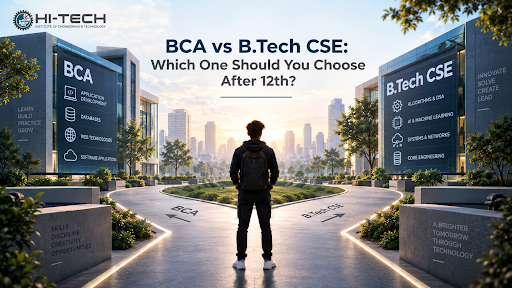
Both lead to computers. Both lead to IT careers. Both are everywhere after Class 12. That’s exactly why students treat BCA and B.Tech CSE as interchangeable, and end up either underprepared for what they actually wanted or overcommitted to something that never suited them.
Whichever path you pick, choosing to do your program from one of the best engineering colleges in Ghaziabad matters just as much as the degree itself. That’s why we’re going to break down where each one really takes you.
What’s the Real Difference Between BCA and B.Tech CSE?
One year separates them, and that year carries more weight than most students expect.
| Parameter | BCA | B.Tech CSE |
| Duration | 3 Years | 4 Years |
| Degree Type | Bachelor of Computer Application | Bachelor of Technology |
| Eligibility | 10+2 (maths preferred, not always mandatory) | 10+2 with PCM, JEE or university entrance |
| Core Focus | Application development, programming, software basics | Systems, algorithms, hardware-software integration, engineering principles |
| Industry Perception | Strong in IT services, application roles | Strong across IT, product companies, core tech, R&D |
| Typical Entry Roles | Software developer, web developer, system analyst | Software engineer, systems developer, data analyst, product engineer |
What Does a BCA Program Actually Cover?
BCA is a focused, application-oriented degree. It’s not an engineering degree, but it’s important to note that it’s a program that covers the practical computing skills most IT jobs actually need day-to-day.
- Programming languages: C, C++, Java, Python
- Database management systems
- Web development and UI design
- Software engineering and project management
- Networking basics and operating systems
- Data structures and algorithms
The BCA program is designed to help students become job-ready in three years, usually at a lower cost, with opportunities to enter IT services companies directly. For students who want to build software and gain practical skills, BCA can be a strong and often overlooked career path.
What Does a B.Tech CSE Program Actually Cover?
B.Tech in CSE goes deeper into computer science and focuses more on the engineering side of technology. The course is designed to prepare students to build and design complex systems, not just use or maintain them.
Key areas usually include:
- Data structures and algorithms: Learning how to organise data and create efficient solutions.
- Operating systems and computer architecture: Understanding how computers work at both software and hardware levels.
- Computer networks and distributed systems: Learning how computers communicate and how large systems work together.
- Compiler design and theory of computation: Understanding how programming languages work and the concepts behind computing.
- Software engineering and system design: Learning how to develop, structure, and manage large software systems.
- Mathematics: Subjects such as discrete mathematics, probability, and linear algebra build the foundation for technical problem-solving.
This combination of theory, mathematics, and engineering is one of the key differences between B.Tech CSE and BCA. B.Tech CSE can also provide pathways towards opportunities in product-based technology companies, core technology roles, research, and competitive exams such as GATE.
Which Path Opens More Doors Later?
This is where the comparison gets genuinely practical.
| Career Goal | BCA | B.Tech CSE |
| Software development at IT services companies | Strong fit | Strong fit |
| Product companies (Google, Microsoft, startups) | Possible with strong skills | Strong fit |
| Data science and machine learning roles | Possible with a PG | Strong foundation |
| GATE / PSU / government teaching roles | Not eligible | Eligible |
| MBA after graduation | Eligible | Eligible |
| M.Sc Computer Science | Eligible | Eligible |
| MCA (Master’s in Computer Applications) | Direct pathway | Less common |
BCA leads naturally into MCA, a well-regarded postgraduate route in IT. A BCA-plus-MCA combination is treated by many recruiters as comparable to a B.Tech in technical depth.
Is BCA Better Than B.Tech CSE?
It depends entirely on the student, not on the subject itself.
BCA suits you if you:
- Want to enter the IT workforce faster
- Didn’t have PCM in Class 12 but still want a strong computing career
- Prefer application-level work over systems-level engineering
- Are cost-conscious and want a shorter, leaner programme
B.Tech CSE suits you if you:
- Want access to the widest possible range of computer science career options
- Are comfortable with four years of technical, mathematics-heavy study
- Are targeting product companies, core engineering roles, or research positions
- Want GATE eligibility or plan to specialise further in AI or systems later
Can BCA Students Actually Get Software Jobs?
Yes, directly and consistently. This is a myth worth putting to rest.
- Large IT services companies like TCS, Infosys, Wipro, and Cognizant recruit BCA graduates regularly
- Startups hire BCA graduates for development roles just as often
- The degree isn’t the barrier; programming proficiency, project portfolio, and interview performance are what actually decide the outcome
The gap between BCA and B.Tech CSE shows up mainly at product companies and roles that specifically list a B.Tech or BE as a requirement. Across the broader IT services market, BCA holds up well on its own.
How Does the Right College Change This Decision?
Whichever path you choose, the institute behind your degree can play an important role in shaping your college experience and career preparation.
- At HIET Ghaziabad, students can choose between BCA and B.Tech CSE, depending on whether they want to build application-focused computer skills or pursue a deeper engineering-oriented education in computer science.
- Both programs at HIET Ghaziabad focus on developing practical technical skills through coding, projects, hands-on learning, and career-oriented preparation, helping students connect classroom learning with industry expectations.
- If you prefer a shorter, application-focused route into the IT field, BCA at HIET Ghaziabad can help you build a foundation in programming, software, and computer applications. If you want a more extensive engineering-focused pathway, B.Tech CSE at HIET Ghaziabad offers deeper exposure to computer science and engineering concepts.
Final Thought
Neither BCA nor B.Tech CSE is the “smarter” degree; they’re built for different starting points and different destinations. Match the program to your own goals, timeline, and comfort with mathematics-heavy study, and choose an institute among the region’s stronger colleges that backs whichever path you pick with real placement support.
FAQ’S
BCA at HIET Ghaziabad focuses on practical computer applications and programming, while B.Tech CSE provides deeper engineering-oriented learning across systems, algorithms, mathematics, and advanced computer science concepts.
Choose BCA at HIET Ghaziabad for a shorter, application-focused computing pathway. Choose B.Tech CSE for deeper technical learning, engineering concepts, and broader computer science career opportunities.
Yes, BCA graduates can pursue software development and other IT roles. At HIET Ghaziabad, practical learning, projects, coding skills, and career preparation can support their journey.
B.Tech CSE generally goes deeper into engineering, mathematics, algorithms, systems, and computer architecture. BCA focuses more on applications, programming, software fundamentals, and practical computing skills.
HIET Ghaziabad offers BCA and B.Tech CSE with practical technical learning, coding exposure, projects, and career-oriented preparation, helping students build relevant skills alongside their chosen degree.