Is Core Engineering (Mechanical/Civil/ECE) Still Worth It in 2027?
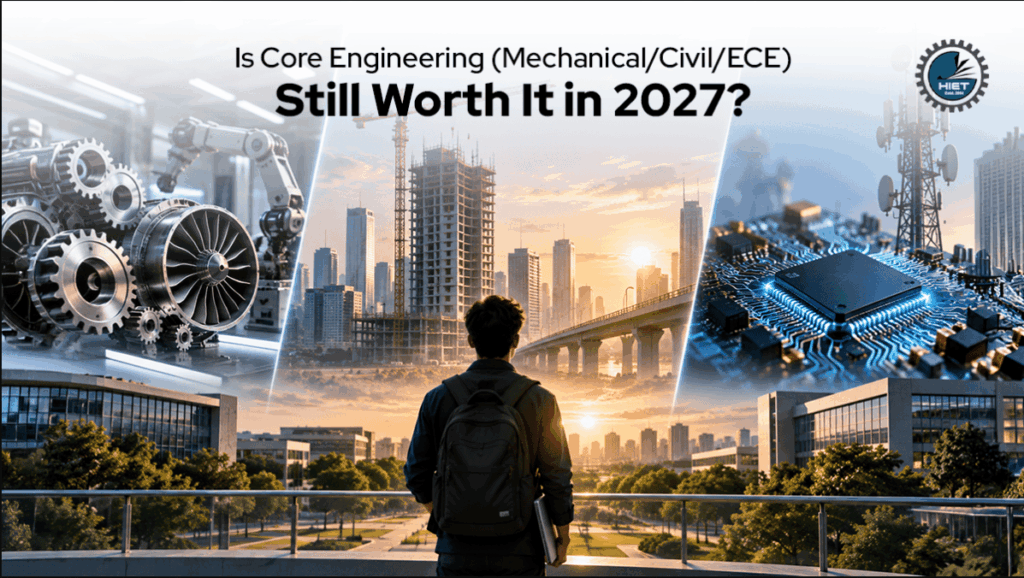
Every admission season, for most engineering aspirants, it’s a common question: should they pick a “safe” core branch or chase CSE and AI? With employability gaps widening between branches, the decision genuinely shapes your first job and salary. Through this blog, we’ll honestly look at where Mechanical, Civil, and ECE actually stand in 2027, and what top engineering colleges in Ghaziabad are doing to keep core branches relevant.
Why Is This Question Even Being Asked Now?
The numbers explain the anxiety. According to the India Skills Report 2026 by ETS and AICTE, Computer Science and IT graduates have employability rates of 80% and 78%, well above the national average of 56.35%. That gap has made students nervous about branches that don’t carry “CS” in the name. But employability data doesn’t tell the whole story. And that is, core branches haven’t disappeared; they’ve changed shape.
Is Electronics and Communication Engineering (ECE) Still Relevant?
ECE went through a rough patch when graduates were mostly absorbed into service companies with limited technical roles. That’s shifted. India’s semiconductor push, nationwide 5G rollout, and the growth of IoT devices have brought ECE back into real demand. VLSI engineers, embedded systems engineers, and RF engineers are now sought after by companies like Qualcomm, Intel, Samsung, and MediaTek.
ECE remains hardware-heavy, so comfort with circuits, signals, and electronics fundamentals matters. Starting salaries sit around ₹3.5–6 LPA, and graduates who add programming skills alongside their core curriculum tend to perform noticeably better in placements.
Does Mechanical Engineering Still Have a Future?
The traditional image of a mechanical engineer working purely on factory floors isn’t where the demand is anymore. But mechanical engineering combined with EV technology, robotics, AI-driven manufacturing, and IoT is very much alive. India’s fast shift to electric vehicles means companies like Tata Motors, Mahindra Electric, and Uber are actively hiring mechanical engineers who understand EV drivetrains, battery systems, and manufacturing automation.
In private-sector starting salaries range from ₹3–5 LPA, while PSUs like ONGC, NTPC, and BHEL pay ₹5–7 LPA through GATE. A mechanical engineer who adds programming, robotics, or EV specialisation has a genuinely strong career path ahead.
Is Civil Engineering Worth Choosing in 2027?
Civil engineering benefits directly from India’s infrastructure push; the government allocated ₹11.11 lakh crore for infrastructure in the Union Budget 2024-25, the highest ever. Roads, metro projects, smart cities, ports, and airports are all expanding, feeding demand for civil engineers.
That said, private-sector starting salaries are the lowest among engineering branches, typically ₹2.5–4 LPA. For students aiming at PSUs or government departments through GATE, civil remains a solid, practical choice.
How Do Core Branches Compare to CSE and AI/ML?
| Branch | Starting Salary | Future Rating |
| CSE / AI / ML | ₹4–8 LPA | 5/5 |
| Data Science & Engineering | ₹4–7 LPA | 4.7/5 |
| Cybersecurity Engineering | ₹4–7 LPA | 4.2/5 |
| Electronics & Communication (ECE) | ₹3.5–6 LPA | 4/5 |
| Mechanical Engineering | ₹3–5 LPA | 3/5 |
| Civil Engineering | ₹2.5–4 LPA | 3/5 |
| Electrical Engineering (EV) | ₹3.5–6 LPA | 3/5 |
The gap is real, but it isn’t unbridgeable. Core branches with future ratings of 3–4/5 still offer solid, stable careers, especially for students who genuinely enjoy the subject matter rather than choosing it as a fallback.
What Should You Do to Make a Core Branch Worth It?
Regardless of the branch, a few additions consistently improve placement outcomes:
- Learn programming alongside your core subjects; ECE and Mechanical graduates who code perform noticeably better in interviews
- Pick up domain specialisations like EV systems, robotics, VLSI, or smart manufacturing instead of generic core coursework
- Prepare for GATE early if a PSU or government role is part of your plan
- Build internships and live projects into your college years rather than relying only on final-year placements
How Are Ghaziabad’s Engineering Colleges Adapting to This Shift?
This is exactly where the choice of institute starts to matter. Top engineering colleges in Ghaziabad are restructuring their B.Tech programs to close the gap between core branches and the CSE advantage by weaving programming, AI tools, and industry projects into every stream rather than keeping them siloed.
Hi-Tech Institute of Engineering & Technology’s B.Tech program is built around this exact idea:
- Students code from Day 1, work with AI-powered tools throughout, and graduate with a job-ready portfolio across 5 career tracks,
- A 6–9 month internship, and 550+ hours of structured training, backed by access to 1,200+ recruiters.
With dedicated faculty heading Mechanical, ECE, EE, and CSE departments, it’s a good example of how Ghaziabad’s engineering institutes are keeping core learning industry-relevant instead of outdated.
Final Thought
Core engineering isn’t dying; it’s evolving. Mechanical, Civil, and ECE graduates who add programming, specialisation, and practical exposure to their core knowledge remain genuinely employable in 2027 and beyond. If you’re evaluating top engineering colleges in Ghaziabad, look for programs that pair traditional core learning with modern, industry-aligned skills; that combination is what will actually future-proof your career.
FAQ’s
Ghaziabad offers Delhi NCR proximity at lower costs. Hi-Tech Institute strengthens this appeal with industry-aligned specialisations, live projects, and placement support, making it a practical alternative to city-based business schools.
Hi-Tech Institute offers Marketing, Finance, HR, Operations, IT & Systems, and International Business specialisations, each backed by case studies, live projects, and industry mentorship to help students build career-relevant expertise.
The 2-year MBA at Hi-Tech Institute costs ₹1,60,000 total, including tuition and registration. Merit-based scholarships up to 20% are auto-applied based on Class 12 scores, making quality education more accessible.
Hi-Tech Institute partners with 100+ recruiters, offering mock interviews, GDs, and simulations. Top performers have secured average packages of ₹5.6 LPA, with the highest package reaching ₹15 LPA.
Yes. Hi-Tech Institute combines affordable fees, experienced faculty, and strong industry exposure, making it reliable for aspirants seeking a career-focused MBA without a Delhi-based campus price tag.