MCA After BCA: Career Roadmap and Why HIET Ghaziabad Is the Right Choice
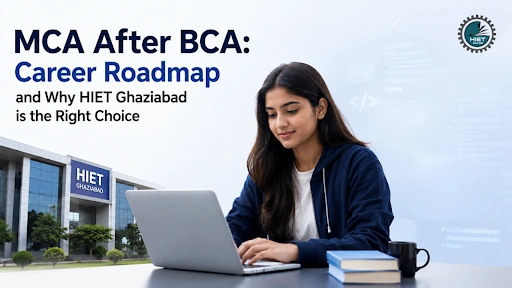
Finished your BCA and wondering what’s next? An MCA could be the smartest move you make for your IT career. Going for a Master in Computer Applications contributes a lot to a graduate’s prospects by better streamlining their technical skills and giving them a better standing in the competitive job market.
In this blog, we break these facts further down by taking you through the complete BCA-to-MCA roadmap and build our case on why Hi-Tech Institute of Engineering & Technology is one of the best MCA colleges in Ghaziabad.
BCA to MCA: Why Is It Worth It?
If you’re a BCA graduate torn between jumping into a job or continuing your studies, here’s the honest answer: pursuing MCA after BCA is almost always worth it. An MCA deepens your grasp of coding, software development, and data management while giving you hands-on, industry-relevant experience.
The assurance of this advanced training is also what makes an MCA graduate more appealing to recruiters across sectors, be it banking, healthcare, or e-commerce, for their capabilities and potential.
Simply put, an MCA turns your foundation built during your BCA program into a career-ready skill set.
What Are the Advantages of Pursuing MCA After BCA?
Here are some of the vital points that, as a BCA graduate, you can appreciate while evaluating your decision to go for an MCA degree at some of the best MCA colleges in Ghaziabad:
- Higher Pay: MCA graduates typically have better starting salaries than BCA-only candidates, since employers value the added effort spent in honing their technical knowledge and the problem-solving ability that an MCA brings to the table.
- Diverse Career Options: From software development to system analysis, database management, and cybersecurity, an MCA opens doors across industries, letting you choose a path that fits your genuine interests.
- Advanced Concepts: You’ll go beyond BCA-level basics into cloud computing, application development, and modern software practices, giving you the depth needed to handle complex, real-world technical challenges confidently.
- International Opportunities: An MCA is a globally recognised postgraduate qualification, which means your skills and degree carry weight even if you eventually want to work with multinational companies or move abroad.
What Does the HIET MCA Program Offer?
Hi-Tech Institute of Engineering & Technology runs a 2-year MCA program built to develop advanced technical knowledge and job-ready skills in computer applications and modern technologies.
The curriculum covers core subjects such as:
- Programming
- Software development,
- Database management,
- Cloud computing,
- Web technologies
- Cybersecurity
- Application development
Our MCA program strives to impart only the most relevant knowledge across these subjects through practical learning, live projects, workshops, and internships. The intent behind our approach is to focus on building analytical thinking, coding ability, and problem-solving skills that map directly to what the IT industry expects today.
What Does the HIET MCA Curriculum Cover?
HIET structures its MCA program around subjects and skills that mirror real industry demands:
- Programming & Application Design: Covers core programming languages and application development practices, helping students write clean, efficient code and build functional, real-world software applications.
- Web & Mobile Development: Focuses on web development, mobile application development, and cloud technologies, preparing students to build applications that work seamlessly across platforms and devices.
- Software Testing & System Analysis: Teaches software testing, project management, and system analysis skills, so graduates can evaluate systems, manage projects, and ensure software quality before deployment.
- Modern Industry Tools: Introduces current tools and technologies used across the software and IT industry, keeping students updated with practices that employers actively use today.
- Professional & Soft Skills: Builds communication, teamwork, and workplace-readiness skills essential for collaborating effectively in real IT teams and client-facing roles.
- Practical Exposure: Delivered through live projects, workshops, and internships, giving students direct, hands-on experience rather than classroom theory alone.
What Career Opportunities Open Up After MCA?
Graduates of the HIET MCA program can explore roles such as:
| Career Path | What They Do |
| Software Developer | Designs and builds applications for finance, healthcare, education, and e-commerce |
| Web Developer | Creates websites and web-based platforms for businesses |
| System Analyst | Studies computer systems and recommends improvements |
| Database Administrator | Designs, manages, and maintains organisational databases |
| Cybersecurity Professional | Protects networks and systems from cyber threats |
| IT Consultant | Advises businesses on technology strategy and implementation |
| App Developer | Builds applications for mobile and other platforms |
What Are the Eligibility and Admission Criteria at HIET Ghaziabad?
Before you apply, here’s what you need to know:
| Requirement | Details |
| Educational Qualification | Bachelor’s degree of minimum 3 years’ duration from a recognised university |
| Minimum Marks | 50% in graduation (45% for SC/ST candidates) |
| Documents Required | 10th & 12th marksheets, undergraduate marksheet, government ID (Aadhar/PAN/Voter ID), recent passport-size photographs |
| Program Duration | 2 years |
| Tuition Fees | ₹1,50,000 |
| Registration Fees | ₹10,000 |
| Total Fees | ₹1,60,000 |
Which Is the Best MCA College in Ghaziabad?
If you’re comparing options, HIET stands out among the best MCA colleges in Ghaziabad for a reason: it combines an industry-aligned curriculum with live projects, internships, and experienced faculty. Add in benefits such as merit-based scholarships and a strong focus on practical, job-ready skills, and it’s easy to see why HIET is consistently mentioned among the best MCA colleges in Ghaziabad by students and parents alike.
Conclusion
Overall, the main motto of moving from a BCA to MCA isn’t just adding another degree, but rather it’s about building the depth, confidence, and practical skills that today’s IT industry demands. With a curriculum designed around real-world application, live projects, and strong placement-oriented training, HIET Ghaziabad makes a compelling case as one of the best MCA colleges in Ghaziabad for students ready to take the next big step in their tech careers.
FAQ’s
Yes, MCA builds on BCA fundamentals with advanced concepts like cloud computing and application development. At HIET, this depth translates into stronger technical skills, better salary prospects, and wider career options across software, database, and cybersecurity roles in the IT industry.
HIET combines an industry-relevant MCA curriculum with live projects, internships, and experienced faculty. Its practical, placement-focused approach, along with automatic merit scholarships based on Class 12th marks, makes it a strong choice among the best MCA colleges in Ghaziabad.
Candidates need a bachelor’s degree of at least 3 years from a recognised university, with a minimum of 50% aggregate marks (45% for SC/ST candidates). Required documents include 10th and 12th marksheets, the UG marksheet, a government ID, and passport-size photographs.
HIET’s MCA graduates can pursue roles such as software developer, web developer, system analyst, database administrator, cybersecurity professional, IT consultant, or app developer. The program’s practical training through live projects and internships prepares students for these industry-ready positions.

I’m Pradeep Bhardwaj, Head of the Electronics & Communication Engineering Department, with 12 years of academic and 8 years of industrial experience. Bridging the classroom and the industry, I focus on practical, future-ready learning that turns students into confident, job-ready engineers. Here I write about engineering education, electronics & communication careers, admissions, and campus learning — helping students make informed choices and build skills that matter in the real world.