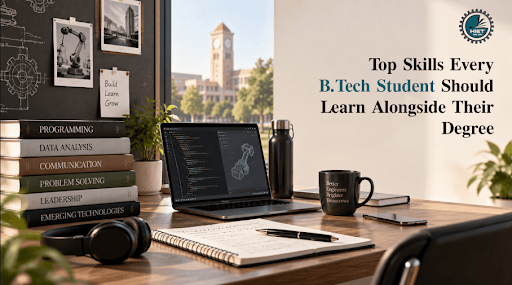
Top Skills Every B.Tech Student Should Learn Alongside Their Degree
Picture this: two engineers graduate with the same B.Tech degree. One walks into interviews with a portfolio showcasing real projects and hands-on certifications. The other has only textbook knowledge. Who gets hired first? The answer is obvious, and it’s why smart students are no longer treating their degree as the finish line.
They’re pairing it with practical skills, tools, and a B.Tech with industry certifications to stay ahead. So if you’re wondering what actually separates a job-ready engineer from the rest, keep reading; this blog breaks down the exact skills you should be building right now, alongside your degree.
Why Should B.Tech Students Look Beyond the Syllabus?
Technology changes every few months, and a student who relies only on textbook knowledge often graduates a step behind the industry. Skills like AI tools, cloud platforms, and communication training are changing how candidates are evaluated for future career opportunities. This is exactly why a BTech with industry certifications has become the preferred path for students who want to be job-ready on day one, not job-ready after months of upskilling.
What Are the Top Skills Every B.Tech Student Should Master?
Here are the core skills that matter most, along with why each one counts.
- Strong Programming and Core Technical Foundations — Whether your branch is CSE, ME, EE, or CE, fundamentals come first. Languages like Python, C++, and Java, along with subjects like Data Structures & Algorithms, form the base every other skill is built on.
- Problem-Solving and Analytical Thinking — Engineering is applied problem-solving. Coding challenges, lab work, and hackathons train students to break down complex issues and design efficient solutions, a habit that pays off in every technical interview.
- Communication and Teamwork — No engineer works alone. Presenting ideas clearly, writing reports, and collaborating in project teams are skills recruiters actively screen for, often before they even look at technical scores.
- Industry Tools and Software Proficiency — Git, cloud platforms, CAD/CAM software, simulation tools, and AI frameworks are now expected knowledge, not bonus skills. Familiarity with these tools shortens the gap between classroom learning and the first day at work.
- AI and Emerging Technology Exposure — Artificial Intelligence, Machine Learning, Data Science, and Cyber Security are reshaping every engineering branch. Students who get early, structured exposure to these areas — ideally through a BTech with industry certifications — build a real edge over peers who only study them theoretically.
- Internship and Live Project Experience — Applying classroom concepts to real assignments teaches students what no textbook can: deadlines, client expectations, and workplace collaboration.
- Adaptability and Professional Ethics — Technology will keep changing. Engineers who stay curious, keep learning, and hold themselves to strong ethical standards are the ones who build lasting careers.
How Does HIET’s B.Tech Program Build These Skills?
HIET’s B.Tech is a 4-year, AICTE-approved, AKTU-affiliated program built specifically to combine the core degree with hands-on, industry-facing training. Here’s how it delivers on each point above:
- Specialisation Choice: Students can pick from B.Tech CSE (powered by Sunstone), B.Tech CSE (powered by Mirai), or B.Tech AI/ML (powered by Mirai), letting them align their degree with the technology track they want to build a career in.
- Structured Industry Training: The Sunstone track alone includes 550+ hours of structured training and access to 1,200+ recruiters, giving students a genuine BTech with industry certifications advantage over a purely theoretical program.
- AI-Integrated Coursework: Both Mirai tracks weave AI Tools & Future-Ready Skills, Data & Analytics in Practice, and Career Tracks & Specialisations directly into the curriculum, rather than treating them as add-ons.
- Internship Exposure: Students get a 6- to 9-month internship built into the program, turning classroom concepts into workplace-ready experience before graduation.
- Placement Support: With 120+ recruiting companies visiting campus and a highest package of ₹15 LPA (average ₹5.6 LPA), the training is directly tied to measurable outcomes.
Hi-Tech Insitute of Engineering and Technology B.Tech Program Snapshot
| Specialisation | Duration | Tuition Fee | Key Focus Areas |
| B.Tech CSE (Sunstone) | 4 Years | ₹4,70,000 | DSA, Programming Fundamentals, Full Stack Development, Data Science & Engineering |
| B.Tech CSE (Mirai) | 4 Years | ₹10,70,000 | AI Tools, Communication Skills, Data & Analytics, Career Tracks |
| B.Tech AI/ML (Mirai) | 4 Years | ₹10,70,000 | AI & ML, Deep Learning, Automation, Cloud Technologies |
Eligibility at a Glance
| Requirement | Details |
| Academic Qualification | Passed Class 12 with PCM |
| Minimum Marks | 45% (40% for reserved categories) |
| Entrance Exams Accepted | JEE Main, UPCET, or direct merit-based admission |
| Documents Needed | 10th & 12th mark sheets, photographs, government photo ID |
Conclusion
Technical knowledge alone no longer guarantees career success; problem-solving, communication, tool proficiency, and real industry exposure matter just as much. Programs like HIET’s B.Tech, built around AI integration, structured training, and internships, give students exactly this combination. Choosing a B.Tech with industry certifications isn’t just about adding a credential; it’s about graduating genuinely ready for the industry you’re stepping into.
FAQ’s
Technology evolves faster than syllabi update. A B.Tech with industry certifications at HIET ensures students master AI tools, cloud platforms, and real-world skills, making them job-ready from day one rather than after graduation.
HIET offers B.Tech CSE (powered by Sunstone), B.Tech CSE (powered by Mirai), and B.Tech AI/ML (powered by Mirai), letting students align their degree with the exact technology track they want to build a career in.
HIET integrates 550+ hours of structured training, AI-driven coursework, and a 6- to 9-month internship into its B.Tech program, turning classroom learning into practical, workplace-ready experience well before graduation.
HIET hosts 120+ recruiting companies on campus each year, with placements reaching a highest package of ₹15 LPA and an average of ₹5.6 LPA, backed by 1,200+ recruiter access through its Sunstone track.
Candidates who passed Class 12 with Physics, Chemistry, and Mathematics, scoring at least 45% (40% for reserved categories), can apply via JEE Main, UPCET, or direct merit-based admission at HIET.